How Long Does PSA Grading Take? Real Turnaround Times
The question every submitter asks weekly (then daily, then hourly): where are my cards? PSA turnaround is the hobby’s favorite waiting room, and the honest answer is that the estimate you saw at checkout measures something different from the wait you experience. Here’s how long each tier really takes, what the status stages mean, and a calculator for the date your slabs actually come home.
Key Takeaways
- Value and bulk tiers: plan 45-70 business days as of mid-2026. Express: days.
- Estimates count business days from order entry, not from the day you shipped.
- The Grading stage takes longest; grades usually appear during Assembly.
- Hobby volume spikes stretch every tier, so submit hype cards early or ride them out.
Table of Contents
Turnaround by Tier
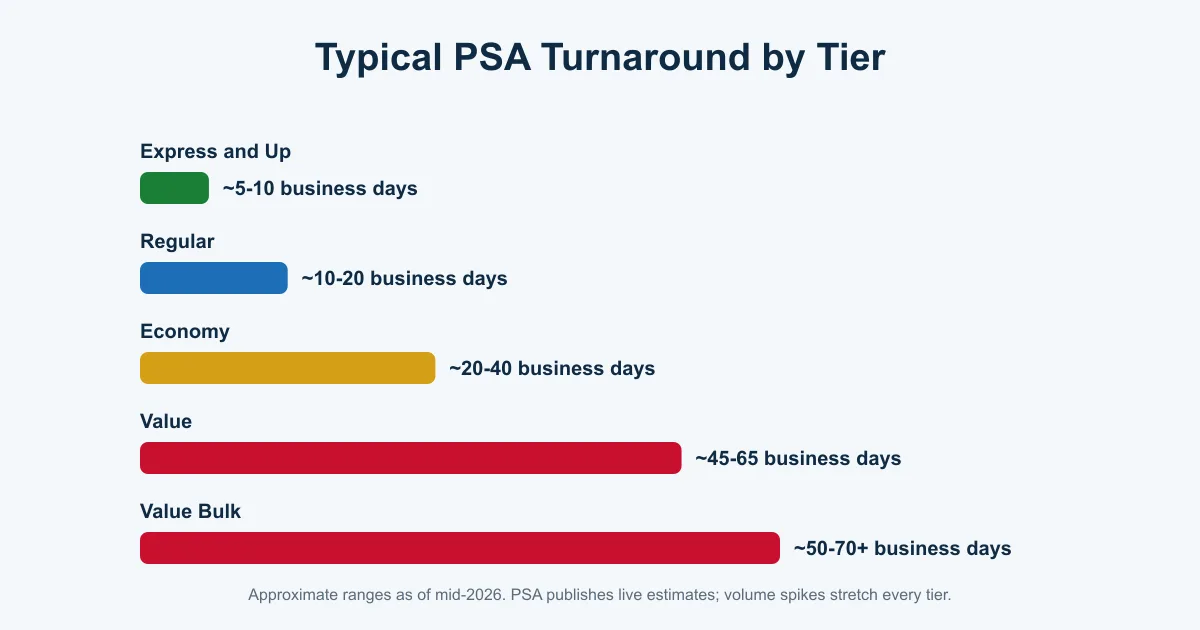
Planning ranges as of mid-2026 (PSA publishes current estimated turnarounds, which are the live numbers):
| Tier | Typical Range | The Vibe |
|---|---|---|
| Express and up | ~5-10 business days | Grades before you miss them |
| Regular | ~10-20 business days | A few weeks of mild checking |
| Economy | ~20-40 business days | A month-plus of pretending not to check |
| Value | ~45-65 business days | A season of your life |
| Value Bulk | ~50-70+ business days | Submit, forget, be surprised |
Note the unit: business days. Sixty business days is roughly three calendar months, which is the single most common turnaround surprise. The cost breakdown covers what buying each speed costs; the short version is that patience is the best-paid hobby skill.
Why Estimates Lie a Little
Three honest reasons the checkout estimate and your experience diverge:
- The clock starts late. Estimates measure from order entry into PSA’s system, not from your shipping day. Transit plus intake queue can add one to three weeks before day one begins.
- Volume waves. When a rookie goes supernova or a grading-hype cycle hits, everyone submits at once and every tier stretches. The slow tiers stretch most because that’s where the wave lands.
- Stage variance. Two orders on the same tier can diverge by weeks depending on what Research and ID turns up: odd variants, tricky identifications, and O-Pee-Chee quirks all take human minutes that multiply across a queue. Set identification is the fixable part: listing cards accurately (checklists at the Trading Card Database resolve most ambiguity) keeps your box out of the slow lane.
None of this is scandal, just queueing math. Budget the top of the published range plus two weeks, and you’ll mostly be pleasantly surprised.
The Order Status Stages, Decoded
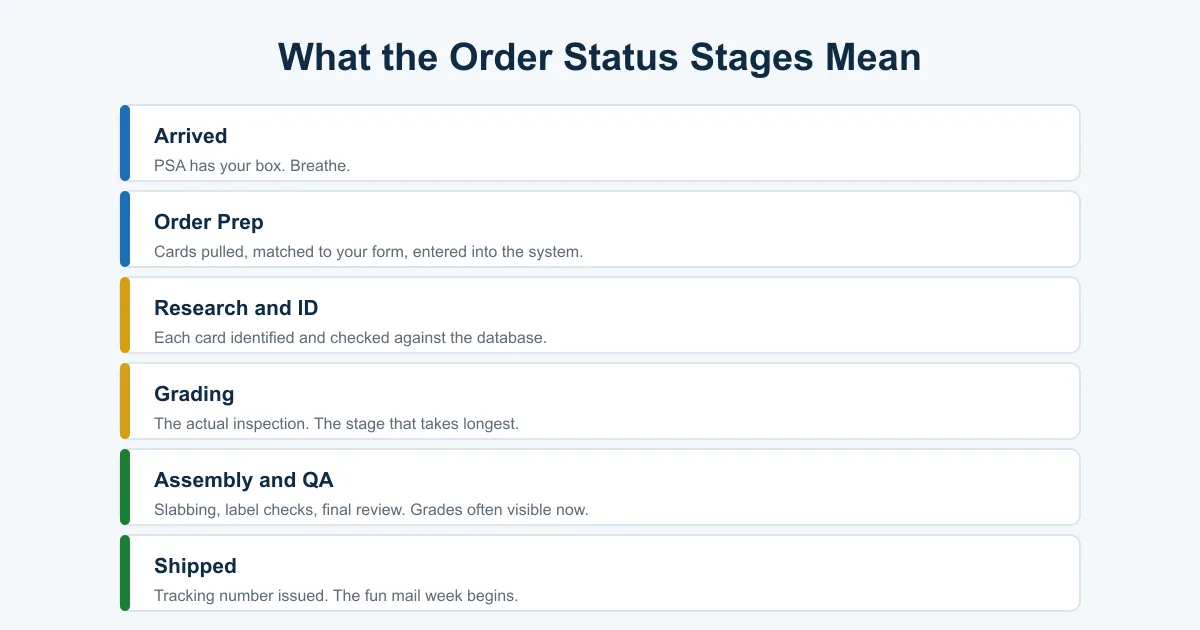
- Arrived: the box is in the building. This stage can hold for days during busy intake; nothing is wrong.
- Order Prep: box opened, cards matched to your manifest. Packing errors surface here, which is why order and packing discipline pays.
- Research and ID: every card identified against the database. Usually quick, occasionally the slow stage for odd cards.
- Grading: the actual inspection. The longest stage on slow tiers, and the one where refreshing does the least.
- Assembly and QA: slabbing, labels, final checks. Grades typically post to your account during this stage, which is the moment the whole wait was for.
- Shipped: tracking live, slabs inbound, mail carrier suddenly very important to you.
When Will My Slabs Arrive? Calculator
Slab ETA Calculator
Estimate the real-world date range for your order.
Does the Wait Cost You Money?
Sometimes, and it’s worth pricing. A hype rookie submitted at peak often returns to a cooler market: three months is a long time in modern card prices, and the chart on Card Ladder for any recent hot rookie shows exactly what a 90-day round trip can do. Meanwhile vintage barely notices a season. The practical rules that fall out:
- Vintage rides slow tiers happily. Its market moves in years, not news cycles.
- Hype cards need express math. If the premium you’re chasing is a hype premium, either pay for speed and keep some of it, or accept that you’re grading for the post-hype price.
- Neutral cards just wait. For the typical star rookie a year past debut, the market in month three looks like the market in month one, and the slow tier’s discount is free money.
Waiting Well
Hard-won advice for the long tiers:
- Log what you sent. Cards, declared values, and your honest grade predictions. Grading day is more fun with receipts, and your prediction accuracy is the most useful skill to calibrate.
- Don’t watch the market daily. A hype card cooling during your wait is out of your control; you priced the submission on the math at entry, and the math was either right or it wasn’t.
- Use the wait. Sort the next shortlist, update your sold-price comps, or write up the collection. Sixty business days is a content calendar, ask me how I know.
The slabs always come home eventually, the grades are always partly a surprise, and the refresh-the-page morning when they post remains one of the genuinely great small joys in this hobby. The wait is the price; the reveal is the show.
Turnaround figures are planning approximations as of July 2026. PSA’s published estimates are the live authority and shift with volume. Not financial advice.
Frequently Asked Questions
How long does PSA grading take?
As of mid-2026, plan on roughly 45 to 70 business days for value and bulk tiers, 20 to 40 for economy, 10 to 20 for regular, and days for express and faster. PSA publishes live estimates, and hobby volume spikes stretch every tier.
Why is PSA taking longer than the estimate?
Turnaround estimates start when your order enters the system, not when the box arrives, and popular submission waves back up the queue. Research and ID or grading stages holding for weeks is normal on slow tiers.
What do the PSA order status stages mean?
Arrived means the box is there, Order Prep and Research and ID mean cards are being logged and identified, Grading is the actual inspection, Assembly is slabbing and QA, and Shipped means tracking is live. Grades usually appear during assembly.
Can I speed up a PSA order after submitting?
Not really. The tier you paid sets the queue. If timing matters, pay the faster tier upfront or use the slow wait as a feature: the market cools on hype cards while patient submissions ride.