Is Grading Cards Worth It? Run the Actual Numbers
“Should I grade this?” is the most-asked question in the hobby, and it has an actual answer: not a vibe, an equation. Expected value after grading versus selling raw, computed with real sold prices and honest gem odds. This page is the full version of that math, with the calculator to run it on any card, and the honest map of when grading wins, loses, and secretly isn’t about money at all.
Key Takeaways
- Grading is worth it when expected graded value beats raw value plus all-in fees.
- The whole equation swings on gem odds: honest condition assessment is the skill.
- Vintage forgives, modern punishes: mid-grade modern submissions lose almost always.
- Protection and sentiment are legitimate reasons that skip the math. Budget them as costs.
Table of Contents
The Break-Even Equation
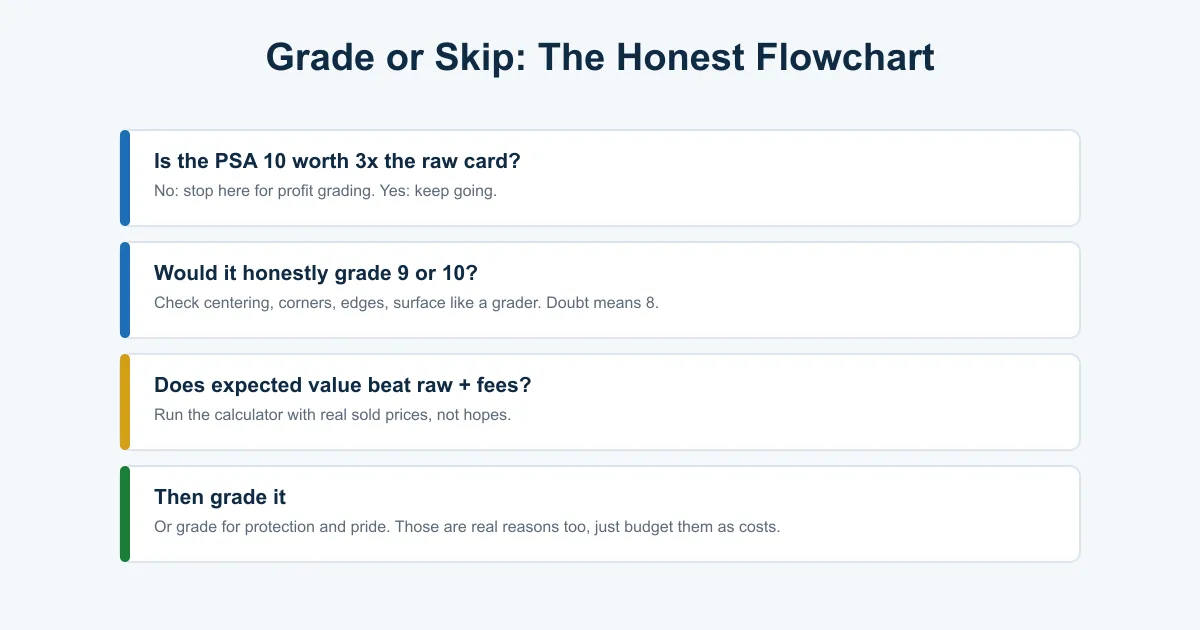
The whole decision in one line:
Expected value = (P(10) × PSA 10 price) + (P(9) × PSA 9 price) + (P(8 or worse) × that price) − all-in fees
Grade when that number meaningfully beats the raw sale price; skip when it doesn’t. Every input is knowable: prices from sold listings, fees from the cost breakdown (spread across your whole submission), and probabilities from honest condition assessment sharpened by the population report ratio for your card.
The word “meaningfully” earns its place: grading also costs months of turnaround and market risk, so a $5 edge isn’t worth the ride. I want the math to win by 20 percent or more before a for-profit card ships.
The Full ROI Calculator
Grading ROI Calculator, Full Version
Three grade outcomes, all-in fees, and the verdict. Prices from recent solds, odds from honesty.
The quick version of this calculator lives in the values guide, and there is a standalone grading ROI calculator in the tools section; this one adds the 8-or-worse floor, which is exactly the input that catches overconfident submissions before they ship.
Where the Math Usually Lands
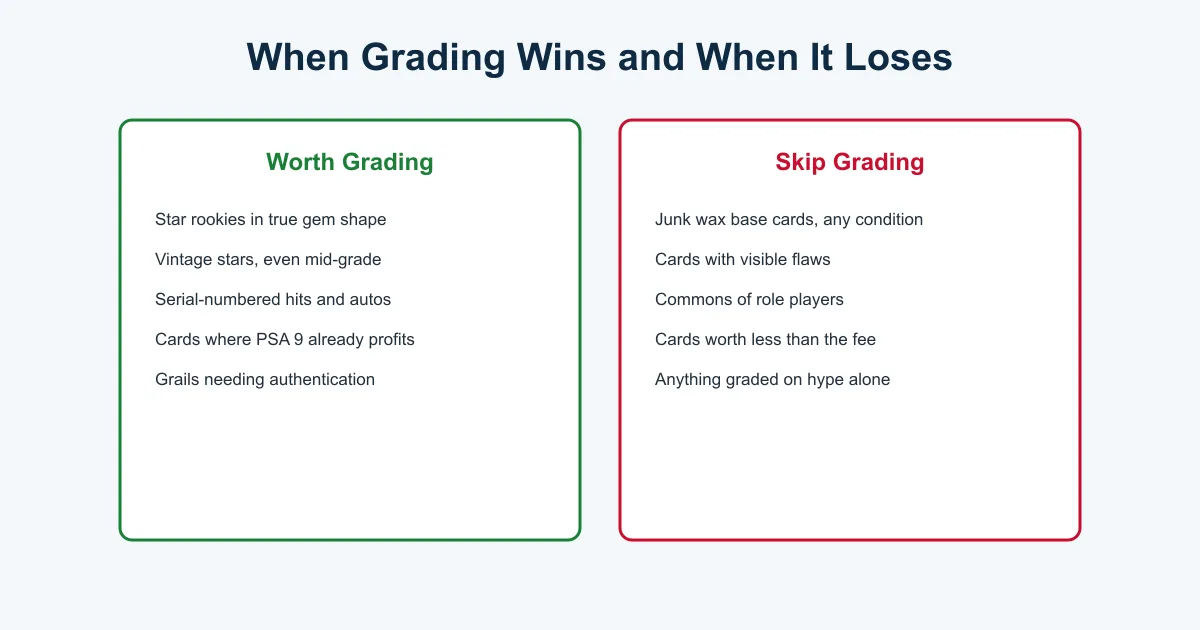
Running this equation across hundreds of real cards produces reliable patterns:
- Wins: star rookies in genuine gem shape. The 9-to-10 jump on desirable modern rookies is the engine the whole equation exists for.
- Wins: vintage stars, even mid-grade. Multiple profitable outcomes instead of one, plus authentication value. A presentable O-Pee-Chee star is the safest submission in hockey.
- Wins: serial-numbered hits and autos. Scarcity already proven, trust premium large.
- Loses: junk wax below perfect. The 90s guide exists because this submission keeps happening anyway.
- Loses: any card whose flaws you’ve already spotted. You found it in your kitchen; the grader will find it in a grading room.
- Loses: cheap cards riding hype. Sub-$50 cards need heroic gem premiums to clear fees, and hype premiums decay during the turnaround wait.
The Inputs That Decide Everything
Garbage in, confident garbage out. The three inputs that actually move the answer:
- The PSA 10 comp. Use recent solds, not the one delusional listing. Thin comps (one sale, months old) deserve a haircut.
- Your gem probability. The input everyone inflates. Anchor it: start at the population report’s gem rate for the card, then adjust down for every flaw you can see. My own tracked predictions run overconfident by about one grade, and I do this constantly.
- All-in fees. Tier price plus shipping plus membership share, divided across the submission, per the true-cost calculator. $25 becomes $32 fast.
A Worked Example
Numbers make it concrete. Say a modern star rookie sells raw for $60. Recent solds on eBay show the PSA 10 at $250, the 9 at $90, the 8 at $45, and your all-in fee across the submission is $30. The population report shows the card gems about a third of the time, but your copy has one borderline corner, so you honestly call it 25% ten, 55% nine, 20% eight.
Expected value: (0.25 × 250) + (0.55 × 90) + (0.20 × 45) − 30 = 62.5 + 49.5 + 9 − 30 = $91, against $60 raw. That’s a $31 edge, or about 50%: comfortably past the meaningful bar, and this card ships. Change one input (the corner drops you to 10% ten) and the EV falls to $76.5, a thinner but still positive edge. Change two (the 10 comp is really $180 on recent solds) and it’s barely break-even, and the raw sale wins on time alone. That sensitivity is the entire lesson: run your real numbers, not the daydream set.
Grading for Love: The Non-Math Reasons
And then there’s the other ledger. My best Phil Kessel cards are slabbed. The math on grading them was terrible and I’d do it again tomorrow: the slab protects the card, displays it like it matters (because to me it does), and authenticates it for whoever inherits this obsession.
Protection, display, provenance, and plain sentiment are real reasons to grade a card. The only discipline required is honesty about which ledger a submission belongs to: business cards must pass the calculator, love cards just have to be loved. It’s the cards submitted on business logic with love math (or love logic with business hopes) that come home as expensive lessons.
Expected value models simplify a messy market. Prices, fees, and gem rates change; verify every input against current data before submitting. Not financial advice.
Frequently Asked Questions
Is it worth grading cards under $50?
Rarely for profit. With fees and shipping near $25-30 per card all-in, a sub-$50 card must gem into a strong PSA 10 premium just to break even. Grade cheap cards for protection or sentiment, not returns.
What percentage of cards get a PSA 10?
It varies enormously by card and era. Condition-sensitive sets gem in single-digit percentages while some modern cards gem at a third or more of submissions. The PSA population report shows the ratio for your exact card.
Is grading worth it for vintage cards?
More often than for modern. Vintage tolerates mid grades, authentication carries real value on its own, and the fee is small next to typical vintage star prices. A presentable vintage star is usually a sensible submission.
Should I grade cards I plan to keep?
If the card matters to you, yes: slabs protect, display beautifully, and authenticate. Just book the fee as a cost of enjoying the hobby rather than an investment, and use the cheapest tier.